|
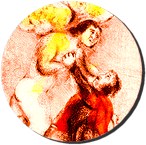
Our Torah portion this week (Vayishlach) includes the account of how Jacob separated himself from his family to pray just before he was to encounter his estranged brother Esau. Sometime during his prayers, however, and a mysterious "man" appeared out of nowhere and confronted him. The details of this confrontation are not given, but apparently Jacob felt the need to wrestle with this man, and the match went long into the night. Just before daybreak, however, the man "wrenched Jacob's hip socket" so that his hip was dislocated, but Jacob - undoubtedly in pain - still refused to let go. Jacob then said to the man: "I will not let you go unless you bless me." This is the first hint that this was no ordinary man, but rather a "theophany," that is, a revelation of the LORD Himself.
The "man" then asked Jacob, "What is your name?" and he replied, "Jacob" (i.e., יַעֲקֹב, "supplanter" or "grappler"). Then he said, "Your name shall no longer be called Jacob, but Israel (יִשְׂרָאֵל), for you have striven (שָׂרִיתָ) with God and with men, and have prevailed." Then Jacob asked him, "Please tell me your name." But he said, "Why is it that you ask my name?" And there he blessed him" (Gen. 32:28-29).
Note that the blessed name "Israel" is a "play on words" from lisrot (לִשְׂרוֹת) meaning "to contend or wrestle" (3ms imperfect יִשְׂרֶה, "he wrestled") combined with the word "God" (אל) as the direct object, and therefore "Israel" can be understood as "God wrestler."
A clue that this is a valid interpretation of the name "Israel" comes from the prophet Hosea who wrote: "In the womb he (i.e., Jacob) took his brother by the heel, and in his manhood he strove with God (שָׂרָה אֶת־אֱלֹהִים); yea he strove with the Angel (וָיָּשַׂר אֶל־מַלְאָךְ) and prevailed; he wept and sought his favor" (Hos. 12:3-4).
At any rate, we know that the mysterious Man was none other than God himself, both because Jacob named the place of his struggle "Peniel" (פְּנִיאֵל), "God's face" (Gen. 32:30) and later the LORD met with Jacob at Bethel and there reaffirmed his new name as "Israel" (see Gen. 35:10).
It is interesting that following the narrative of Jacob's struggle with the angel, Moses added the comment: "This is why the people of Israel do not eat "gid ha'nasheh"(the nerve that passes along the hip socket) to this day, because he (i.e., the angel) struck Jacob's hip at its socket" (Gen. 32:32).
This verse is peculiar because it interjects a dietary restriction in relation to Jacob's limp as a memorial of his struggle, namely that the descendants of Israel would remember the origin of their heritage. Structurally it is a bit odd to read Moses' comment about this event in narrative of the Torah, especially since Jacob's ordeal with the Angel had occurred long before Moses' time, but there are no wasted words in the Torah, and therefore these questions provide an opportunity to look deeper into its significance.
So why did the Israelites make it a custom not to eat the nerve (i.e., gid: גִּיד) of a slaughtered animal, including the tendon (i.e., nasheh: נָשֶׁה) that runs down the back of the leg of an animal (together this is called gid ha'nasheh (גִּיד הַנָּשֶׁה)? After all, most Jews would never think of eating the nerve and tendon of an animal, and therefore the sages sought for a metaphorical meaning regarding Moses' statement, and they came to associate the gid ha'naseh with the carnal nature, that is, with animal forces of earthiness and bodily desire (i.e., the "flesh" in the New Testament), and that it why God had crippled Jacob there.
Others note that the term gid ha'nasheh can literally be read as the "nerve (or sinew) of forgetfulness," from the root word nashah (נָשָׁה) meaning to "forget" (see Gen. 41:51). Understood this way the custom not to eat this part of an animal was meant to teach us to forget the carnal ways of our past to move forward in victorious faith (Phil. 3:13-14).
It is said by the sages that a person who is proud and haughty is like one who denies the existence of the LORD, as it is written: "And your heart will become haughty (וְרָם לְבָבֶךָ) and you shall forget the LORD your God (וְשָׁכַחְתָּ) who brought you out of the house of slavery" (Deut. 8:14). Note that the Hebrew word for "forget" (i.e., shakhan: שָׁכַח) can mean to wither (ξηραίνω) and become useless (John 15:6, James 1:11). As it is written in Psalm 137:5, "If I forget you (אֶשְׁכָּחֵךְ), Jerusalem let my right hand wither (תִּשְׁכַּח)." Likewise Yeshua taught us to "abide" in Him lest we should be removed from the root and wither (see John 15:1-8).
Pride is the original sin itself, denying the very First Commandment itself: "I am the LORD thy God (אָנכִי יְהוָה אֱלהֶיךָ) who brought you out of the house of slavery" (Exod. 20:2). Exalting the ego by "forgetting" about the LORD - that is, by suppressing the truth of His reality, power, and glory - invariably leads to inward withering. Just as the ego attempts to "puff itself up" and to enlarge itself, so forgetting about God leads to a corresponding withering of soul, a diminution of heart. This is yet another example of the spiritual principle: "the first shall be last and the last shall be first" (Mark 9:35; Matt. 20:25-26).
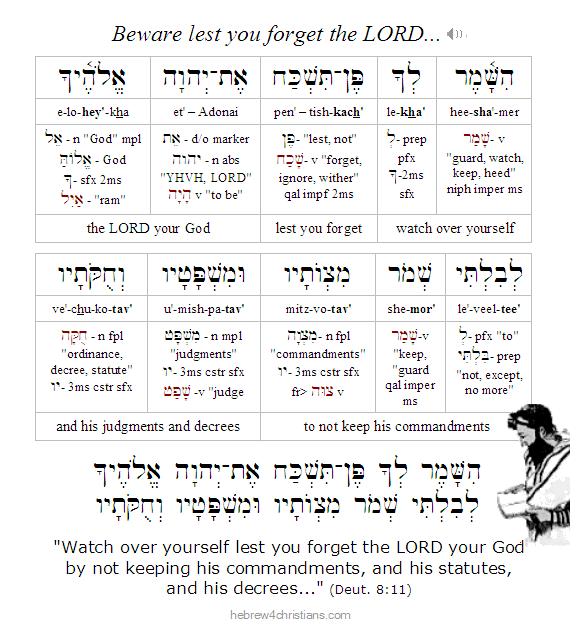
Hebrew Lesson
Deut. 8:11 Hebrew reading (click):
 |
<< Return
|